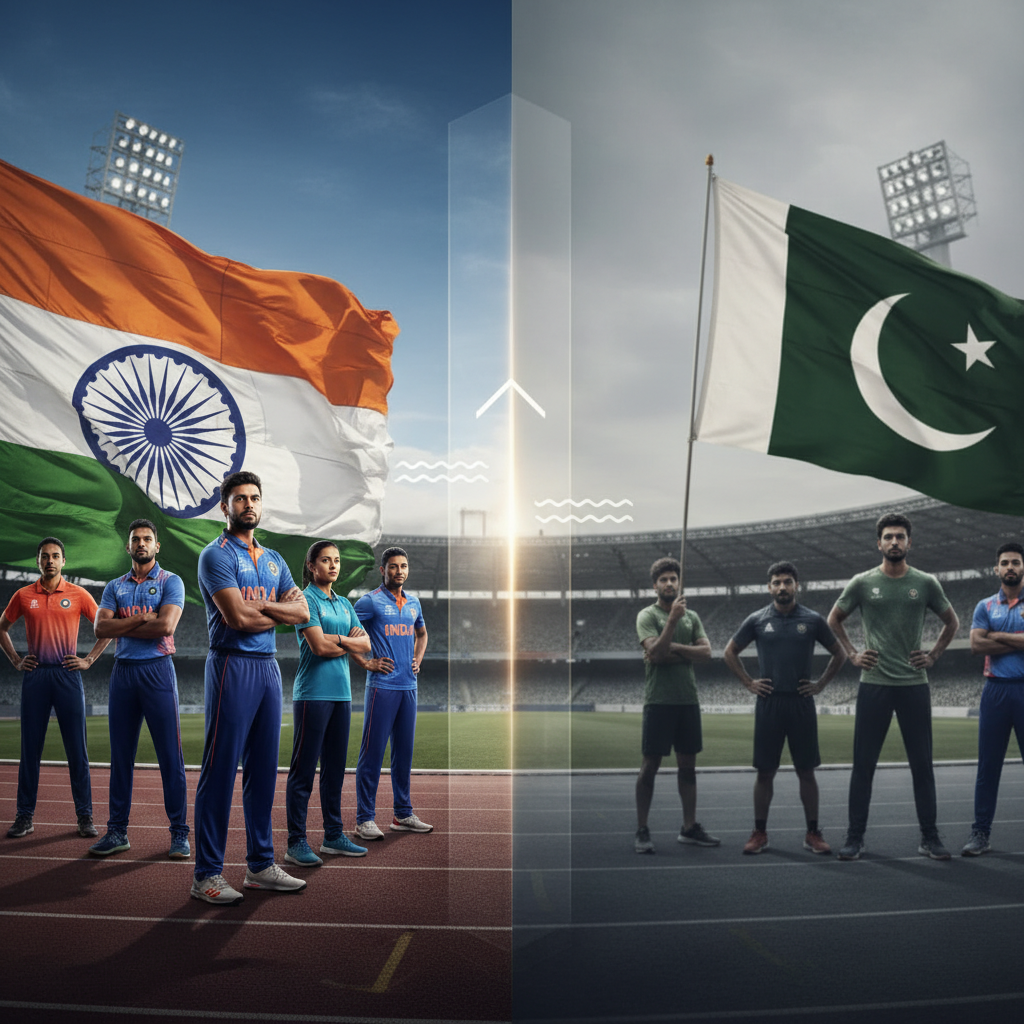
NEW DELHI, India – In a significant clarification of its long-standing approach, the Indian government has officially outlined its sports policy concerning Pakistan. The directive, set forth by the Ministry of External Affairs and Ministry of Home Affairs, establishes a dual-pronged strategy: a firm ‘no’ to bilateral sporting engagements with Pakistan, while unequivocally opening India’s doors for Pakistani athletes to participate in global, multi-sport events hosted on Indian soil.
A Firm Stance on Bilateral Engagements
The core of the new policy unequivocally states that India will not engage in bilateral sporting series or competitions against Pakistan across any sport. This means no home-and-away cricket series, no standalone hockey matches, or any other direct sporting contests between the two nations that are not part of a larger international tournament. This decision reinforces India’s consistent position, which has largely seen a cessation of bilateral sporting ties since the Mumbai terror attacks in 2008, with only sporadic exceptions and a general freeze due to prevailing geopolitical tensions.
Sporting federations across India, including the Board of Control for Cricket in India (BCCI), Hockey India, and others, are now bound by this clear government mandate. While these bodies typically operate with autonomy, matters concerning international relations and national security fall under the purview of government policy. This directive removes any ambiguity and prevents individual federations from unilaterally pursuing bilateral sporting exchanges with Pakistan.
Open Doors for Global Multi-Sport Events
Crucially, the policy makes a distinct and significant exception for global multi-sport events. India will welcome Pakistani athletes and teams to participate in events such as the Olympic Games, Commonwealth Games, Asian Games, or any World Championships that India hosts. This ensures that India can continue to bid for and successfully stage major international sporting spectacles without compromising its stance on bilateral relations with Pakistan.
This aspect of the policy was notably demonstrated during the recent ICC Men’s Cricket World Cup 2023, where the Pakistan cricket team traveled to India for the tournament. Their participation was in line with India’s commitments to the International Cricket Council (ICC) as a host nation and adhered to the spirit of global sporting fraternity. Similarly, if India were to host the Asian Games, Pakistani contingents would be granted visas and full access to participate, subject to standard security protocols.
Rationale Behind the Dual Policy
Government sources indicate that this policy balances India’s national security interests and political concerns with its obligations as a responsible member of the international sporting community. The decision to disallow bilateral ties stems from the ongoing cross-border terrorism and strained diplomatic relations, a position consistently articulated by the Indian government on various international forums. At the same time, by allowing participation in multi-sport global events, India upholds the Olympic spirit and ensures that politics do not entirely overshadow the universality of sport when it comes to international commitments.
This nuanced approach allows India to project strength and resolve on geopolitical matters while continuing to be a major player in hosting global sporting events. It avoids potential bans or sanctions from international sports bodies like the International Olympic Committee (IOC) or the ICC, which often advocate for the separation of sport and politics, particularly concerning visa issuances for participating nations.
Impact on Future Tournaments and Diplomacy
The new policy will have significant implications for future international sporting calendars. For cricket, while a bilateral India-Pakistan series remains a distant dream, the policy confirms Pakistan’s participation in ICC events like the Champions Trophy or future T20 World Cups, should India be the host. This clarity is vital for event planning and security arrangements for such large-scale tournaments.
For other sports like hockey, squash, and badminton, where India and Pakistan have historically been fierce rivals, the policy ensures that their encounters will be confined to continental or world championships. While this might disappoint fans who cherish the intense rivalry, it provides a predictable framework for sports organizations.
Ultimately, this policy signals India’s unwavering commitment to its national interests while strategically navigating the complex landscape of international sports. It draws a clear line, delineating what is permissible and what is not, thereby providing much-needed clarity for all stakeholders involved in the world of sports.